


Summer is supposed to recharge everyone, but it rarely does. People spend months looking forward to a week off, only to come back just as drained as when they left. Work stress has a way of tagging along, whether anyone wants it to or not.
A new Grow Therapy survey of more than 1,000 employed adults in the U.S., which looked at how stress rises and falls before, during, and after time away from work, reinforces this common experience. Nearly half (48%) say they've either canceled a vacation or cut one short in the past year because of work. Rest is supposed to be the whole point of time off, but for a lot of people, it never quite happens.
As a society, people have gotten so used to scrolling, swiping, managing multiple screens, and functioning at such a fast pace that they may not know what to do with the stillness and downtime.
Key takeaways
- Nearly half of respondents (48%) say they've canceled an entire vacation, cut one short, or done both in the past year because of work demands.
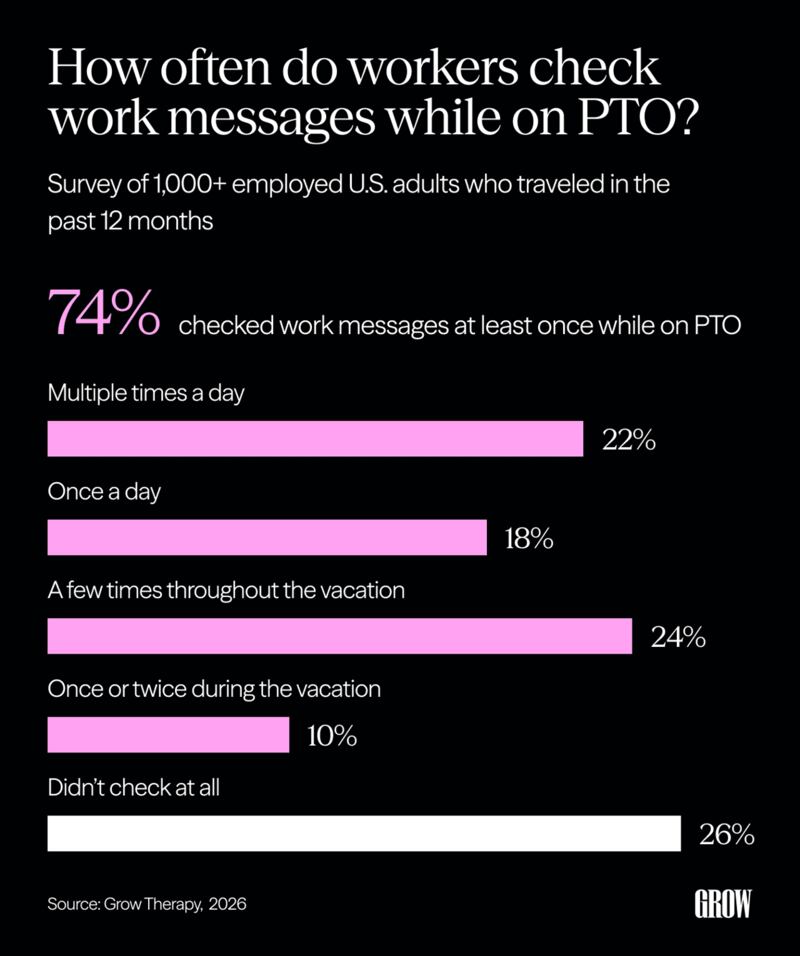
- 74% of employees check work messages while on vacation, and 40% of them check in at least once a day.
- 42% of workers feel more stressed in the week or two leading up to a vacation than during a typical workweek, and 47% returned from vacation feeling the same stress, or even worse.
- 68% would consider therapy to help them manage workplace stress.
Anxious workers skip vacation nearly twice as often as everyone else
Recent research from Texas A&M University tied travel to better heart health, lower stress, and higher productivity.
But in practice, work still gets in the way for many people. Nearly half of the workers surveyed (48%) say they've canceled a whole vacation, cut one short, or done both for work-related reasons over the past year.

Grow Therapy
Money and family pressures frequently pile on top of the strain from work. Nearly 7 in 10 workers (69%) feel financial stress tied to the cost of a trip, and a similar share (68%) feel pulled by family or personal obligations at home. Between the two, there isn’t much room left for people to actually unwind.
42% feel more stressed before vacation than during a normal workweek
The combined pressure of work, money concerns, and family responsibilities builds on something more basic. More than 4 in 10 workers (42%) feel more stressed in the one to two weeks before a vacation than they do during a normal workweek.

Grow Therapy
And that stress doesn't stay contained. Among workers who felt significantly more stressed before being “out of office,” 68% canceled a vacation, cut one short, or both, compared with 38% of those who felt only somewhat less stressed. That helps explain why 47% say they come back from time off feeling just as stressed, or worse, than when they left.
Who feels this stress the most
The data shows that no group feels more stress heading into a vacation than parents. Among workers with kids under 18, 48% reported feeling more stressed before their last vacation, compared with 36% of those with no caregiving responsibilities. Workers caring for aging or ill family members report almost the same level of stress as parents do.
Remote workers are more likely than those in hybrid roles to feel significantly more stressed before a vacation (20% vs. 12%), which runs counter to the assumption that remote work makes stepping away easier.
Age also plays a role in these stress levels. Gen Z workers (ages 18 to 29) are more likely to feel stressed before a vacation than Gen X workers (ages 46 to 61): 44% vs. 33%. That difference in stress shows up in their behavior, too. Gen Z workers are far more likely to say they've canceled or cut short a vacation in the past year (58%) when compared with Gen X workers (34%).
The people who need rest the most struggle to unplug
Even when workers finally get away, many never really leave their work behind. Nearly 3 in 4 (74%) checked work messages at least once during their time off, and 40% checked in daily.
Grow Therapy
That habit of staying tethered to work responsibilities is hardest to shake for workers who were already stressed going into their time off. Nearly five times as many checked their work messages multiple times a day (49%) as those who felt only somewhat less stressed beforehand (10%).
The way that people work also influences their ability to turn off work mode. Hybrid workers were the least likely to fully disconnect. Eighty-five percent checked messages at least once during their time off, compared with 71% of remote workers and 70% of in-office workers.
“Do not bring your work phone, Slack or email unless you have to,” said Alexandra Pelazza, a licensed clinical social worker. “Set clear boundaries and a plan at work to support [with] feelings of guilt. Taking time to unplug literally takes practice and exposure.”
68% would consider therapy to learn how to manage workplace stress
Plenty of people already see therapy as part of the answer, even if they haven't tried it. Sixty-eight percent said they would consider working with a therapist on topics like work-related rest, boundaries, and burnout recovery.
Interest in therapy runs highest among workers who feel the most stressed and those who feel least stressed. Fifty-five percent of workers who felt significantly more stressed before their last vacation said they would definitely consider it, and 40% of those who felt significantly less stressed said the same. Compare that to just 18% of workers whose stress level stayed about the same.
But only a few follow through on that interest in therapy. Only 19% chose to actually turn to it to recover from work stress, while exercise (48%) and sleep (44%) remained the more common go-tos.
4 ways to protect time off before it starts
Mental health experts say setting boundaries before time off even starts makes the biggest difference.
- Set clear work hours, and ask coworkers not to reach out beyond that window if the job allows it.
- Treat PTO like it's part of the job, not an afterthought.
- Say no without over-explaining. A short, clear "no" protects time off just as well as a long excuse does.
- Set expectations before leaving, including which messages, if any, you will check.
Rest needs more than just a day off
Taking time off doesn't automatically deliver quality rest. Many of the workers in this survey admitted that they carried their stress into vacation and stayed tethered to their phones the entire time they were away, only to come home just as worn out as when they left. Adding more vacation days alone won't fix these issues. Changing how people approach PTO, both during time off and in the time leading up to it, would have a greater impact.
Methodology
The survey was conducted online by Centiment, with a total sample size of 1,035 employed U.S.-based adults 18 and older who have taken a vacation or extended time off in the past 12 months. The results are unweighted and have a margin of error of ±3%. Fieldwork was conducted from July 1 to July 9, 2026.
This story was produced by Grow Therapy and reviewed and distributed by Stacker.